
Showing posts with label Conservative. Show all posts
Showing posts with label Conservative. Show all posts
Saturday, March 22, 2014


Monday, April 29, 2013
Anti-Government Fringe Goes Capitalists with their own dating site and merchandising.
Anti-Government Conspiratorial Theories and How To Make Money:
I watched a documentary last night about the current KKK and how they have become much more sophisticated in manipulating political will. They have teamed up with the gun manufacturers and the NRA so they can get even more military weapons. Today the organization has also joined with the Libertarians in the push to over throw the government.
They have gone far beyond the racial, ethnic and religious bigotry. They want to eliminate the current government and install one that deports everyone that is not white-European decent protestant, regardless of citizenship status.
They learned that marches in the street didn't push their cause, but alliances with these other factions did. Their evangelical Protestant position fit very nicely with those religious extremists in also over throwing the government to install a theocracy.
There have been members of the KKK in our congress since post civil war. But they were very few and spread between the two political parties and didn't have enough support to push much in the way of legislation, except the anti-immigration. But then they learned that the GOP was an easy vehicle to manipulate with their coalition to drive legislation they want.
When we elected the first black president, they and so many quiet racists went insane with fear and hate. The Klan's and other similar organization's membership has shot up to levels they've never seen before and they have taken full advantage of that growth. They now know how to lobby fearful senators and congressmembers both with political power through their coalition, money and fear of assassination.
When you add the Koch brothers money and organization, ALEC, the Libertarian Party and the Libertarian caucus of the GOP now called the Tea Party with the money of the Christian Coalition and add to this mix the anti-regulation, anti-tax Wall Street backers, we end up with a very dangerous political party whose only goal is to bring down the government.
So here is another dot to add to the many connecting dots of the underlying movements that are plaguing our culture and nation today.
Friday, September 7, 2012
Differences in Conservative and Liberal Brains
13 peer-reviewed studies show liberals and conservatives physiologically different.
In the 13 peer-reviewed scientific studies summarized below, researchers found that liberals and conservatives have different brain structures, different physiological responses to stimuli, and activate different neural mechanisms when confronted with similar situations. Each entry below references the source document, and in most cases, a PDF of the study has been included. The studies are arranged from most recent to oldest. We included all the peer-reviewed studies on this subject which we could find.
1. Conservatives spend more time looking at unpleasant images, and liberals spend more time looking at pleasant images.

"We report evidence that individual-level variation in people's physiological and attentional responses to aversive and appetitive stimuli are correlated with broad political orientations. Specifically, we find that greater orientation to aversive stimuli tends to be associated with right-of-centre and greater orientation to appetitive (pleasing) stimuli with left-of-centre political inclinations."
Michael D. Dodd, Amanda Balzer, Carly Jacobs, Michael Grusczynszyki, Kevin B. Smith, and John R. Hibbing, "The Left Rolls with the Good; The Right Confronts the Bad. Physiology and Cognition in Politics," rstb.royalsocietypublishing.org, Mar. 5, 2012
2. Reliance on quick, efficient, and "low effort" thought processes yields conservative ideologies, while effortful and deliberate reasoning yields liberal ideologies.

"...[P]olitical conservatism is promoted when people rely on low-effort thinking. When effortful, deliberate responding is disrupted or disengaged, thought processes become quick and efficient; these conditions promote conservative ideology… low-effort thought might promote political conservatism because its concepts are easier to process, and processing fluency increases attitude endorsement.
Four studies support our assertion that low-effort thinking promotes political conservatism... Our findings suggest that conservative ways of thinking are basic, normal, and perhaps natural."
Scott Eidelman, Christian S. Crandall, Jeffrey A. Goodman, and John C. Blanchar, "Low-Effort Thought Promotes Political Conservatism,"PDF logo Society for Personality and Social Psychology, 2012
3. Conservatives react more strongly than liberals to disgusting images, such as a picture of someone eating worms.
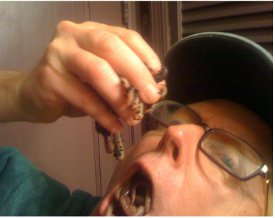 This image of a man eating worms is similar to one that was shown to subjects in the study. Source: Kevin B. Smith, et al., 'Disgust Sensitivity and the Neurophysiology of Left-Right Political Orientations,' www.plosone.org, Oct. 19, 2011
"People who believe they would be bothered by a range of hypothetical disgusting situations display an increased likelihood of displaying right-of-center rather than left-of-center political orientations… In this article, we demonstrate that individuals with marked involuntary physiological responses to disgusting images [measured by change in mean skin conductance], such as of a man eating a large mouthful of writhing worms, are more likely to self-identify as conservative and, especially, to oppose gay marriage than are individuals with more muted physiological responses to the same images."
Kevin B. Smith, Douglas Oxley, Matthew V. Hibbing, John R. Alford, and John R. Hibbing, "Disgust Sensitivity and the Neurophysiology of Left-Right Political Orientations,"PDF logo www.plosone.org, Oct. 19, 2011
4. Liberals have more tolerance to uncertainty (bigger anterior cingulate cortex), and conservatives have more sensitivity to fear (bigger right amygdala).
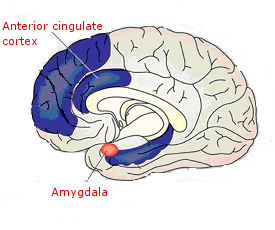
Source: Gary Leisman, et al., 'Intentionality and 'Free-Will' from a Neurodevelopmental Perspective,' www.frontiersin.org, June 27, 2012
"In a large sample of young adults, we related self-reported political attitudes to gray matter volume using structural MRI [magnetic resonance imaging]. We found that greater liberalism was associated with increased gray matter volume in the anterior cingulate cortex, whereas greater conservatism was associated with increased volume of the right amygdala...
...[O]ur findings are consistent with the proposal that political orientation is associated with psychological processes for managing fear and uncertainty. The amygdala has many functions, including fear processing. Individuals with a larger amygdala are more sensitive to fear, which, taken together with our findings, might suggest the testable hypothesis that individuals with larger amagdala are more inclined to integrate conservative views into their belief systems... our finding of an association between anterior cingulate cortex [ACC] may be linked with tolerance to uncertainty. One of the functions of the anterior cingulate cortex is to monitor uncertainty and conflicts. Thus it is conceivable that individuals with a larger ACC have a higher capacity to tolerate uncertainty and conflicts, allowing them to accept more liberal views."
Ryota Kanai, Tom Feilden, Colin Firth, and Geraint Rees, "Political Orientations Are Correlated with Brain Structure in Young Adults,"PDF logo Current Biology, Apr. 7, 2011
5. Conservatives have stronger motivations than liberals to preserve purity and cleanliness.

"...[R]eminders of physical purity influence specific moral judgments regarding behaviors in the sexual domain as well as broad political attitudes...
...[E]nvironmental reminders of physical cleanliness shifted participants’ attitudes toward the conservative end of the political spectrum and altered their specific attitudes toward various moral acts... When taken together, these two sets of results point to the possibility that political orientation may be, in some measure, shaped by the strength of an individual’s motivation to avoid physical contamination and that resulting vigilance for threats to purity may serve to reinforce a politically conservative stance toward the world."
Erik G. Helzer and David A. Pizarro, "Dirty Liberals! Reminders of Physical Cleanliness Influence Moral and Political Attitudes,"PDF logo Psychological Science, Mar. 18, 2011
6. Liberals follow the direction of eye movements better than conservatives.
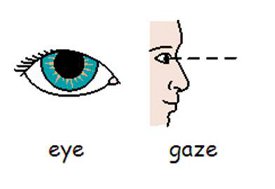
Source: www.candleaac.com (accessed July 13, 2012)
"In the present study, we examine whether gaze cue effects [the ability to follow the direction of another individual’s eye movements or gaze] are moderated by political temperament, given that those on the political right tend to be more supportive of individualism—and less likely to be influenced by others—than those on the left. We find standard gaze cuing effects across all subjects, but systematic differences in these effects by political temperament. Liberals exhibit a very large gaze cuing effect while conservatives show no such effect at various SOAs [stimulus onset asynchrony]...
Perhaps conservatives are less likely to trust others meaning that they are also less likely to trust a gaze cue..."
Michael D. Dodd, John R. Hibbing, and Kevin B. Smith "The Politics of Attention: Gaze Cuing Effects Are Moderated by Political Temperament," PDF logo Attention, Perception & Psychophysics, Jan. 2011
7. Republicans are more likely than Democrats to interpret faces as threatening and expressing dominant emotions.
 "Independent sample t-tests revealed group differences in the averaged threat interpretation scores of the 10 facial stimuli. Republican sympathizers were more likely to interpret the faces as signaling a threatening expression as compared to Democrat sympathizers. Group differences were also found for dominance perceptions, whereby Republican sympathizers were more likely to perceive the faces as expressing dominant emotions than were Democrat sympathizers..."
Jacob M. Vigil, "Political Leanings Vary with Facial Expression Processing and Psychosocial Functioning,"PDF logo Group Processes & Intergroup Relations, 2010
8. When making risky decisions, Republicans consider external consequences (ventral anterior cingulate and bilateral amygdala) while Democrats weigh internal considerations (right insula).

"We matched public voter records to 54 subjects who performed a risk-taking task during functional imaging. We find that Democrats and Republicans had significantly different patterns of brain activation during processing of risky decisions.
...[I]t appears in our experiment that Republican participants, when making a risky choice, are predominantly externally oriented, reacting to the fear-related processes with a tangible potential external consequence. In comparison, risky decisions made by Democratic participants appear to be associated with monitoring how the selection of a risky response might feel internally."
Darren Schreiber, Alan N. Simmons, Christopher T. Dawes, Taru Flagan, James H. Fowler, and Martin P. Paulus, "Red Brain, Blue Brain: Evaluative Processes Differ in Democrats and Republicans," PDF logo American Political Science Association Toronto Meeting Paper, ssrn.com, Aug. 13, 2009
9. Genetics influence political attitudes during early adulthood and beyond.

"The present research attempts to characterize how the transmission of political orientations develops over the life course... [G]enetic influences on political attitudes are absent prior to young adulthood. During childhood and adolescence, individual differences in political attitudes are accounted for by a variety of environmental influences... However, at the point of early adulthood (in the early 20s), for those who left their parental home, there is evidence of a sizeable genetic influence on political attitudes which remains stable throughout adult life.”
Peter K. Hatemia, Carolyn L. Funka, Sarah E. Medlanda, Hermine M. Maesa, Judy L. Silberga, Nicholas G. Martina and Lindon J. Eavesa, "Genetic and Environmental Transmission of Political Attitudes Over a Life Time," The Journal of Politics, July 21, 2009
10. Compared to liberals, conservatives are less open to new experiences and learn better from negative stimuli than positive stimuli.

"In this study, the relations among political ideology, exploratory behavior, and the formation of attitudes toward novel stimuli were explored. Participants played a computer game that required learning whether these stimuli produced positive or negative outcomes. Learning was dependent on participants’ decisions to sample novel stimuli... Political ideology correlated with exploration during the game, with conservatives sampling fewer targets than liberals. Moreover, more conservative individuals exhibited a stronger learning asymmetry, such that they learned negative stimuli better than positive... Relative to liberals, politically conservative individuals pursued a more avoidant strategy to the game…
The reluctance to explore that characterizes more politically conservative individuals may protect them from experiencing negative situations, for they are likely to restrict approach to known positives.”
Natalie J. Shooka and Russell H. Faziob, "Political Ideology, Exploration of Novel Stimuli, and Attitude Formation,"PDF logo Experimental Social Psychology, Apr. 3, 2009
11. Conservatives tend to have a stronger reaction to threatening noises and images than liberals.

"In a group of 46 adult participants with strong political beliefs, individuals with measurably lower physical sensitivities to sudden noises and threatening visual images were more likely to support foreign aid, liberal immigration policies, pacifism, and gun control, whereas individuals displaying measurably higher physiological reactions to those same stimuli were more likely to favor defense spending, capital punishment, patriotism, and the Iraq War. Thus, the degree to which individuals are physiologically responsive to threat appears to indicate the degree to which they advocate policies that protect the existing social structure from both external (outgroup) and internal (norm-violator) threats."
Douglas R. Oxley, Kevin B. Smith, John R. Alford, Matthew V. Hibbing, Jennifer L. Miller, Mario Scalora, Peter K. Hatemi, and John R. Hibbing, "Political Attitudes Vary with Physiological Traits," Science, Sep. 19, 2008
12. Liberals are more open-minded and creative whereas conservatives are more orderly and better organized.

"We obtained consistent and converging evidence that personality differences between liberals and conservatives are robust, replicable, and behaviorally significant, especially with respect to social (vs. economic) dimensions of ideology. In general, liberals are more open-minded, creative, curious, and novelty seeking, whereas conservatives are more orderly, conventional, and better organized... A special advantage of our final two studies is that they show personality differences between liberals and conservatives not only on self-report trait measures but also on unobtrusive, nonverbal measures of interaction style and behavioral residue.”
Dana R. Carney, John T. Jost, Samuel D. Gosling, and Jeff Potter, "The Secret Lives of Liberals and Conservatives: Personality Profiles, Interaction Styles, and the Things They Leave Behind,"PDF logo International Society of Political Psychology, Oct. 23, 2008
13. When faced with a conflict, liberals are more likely than conservatives to alter their habitual response when cues indicate it is necessary.

"Our results are consistent with the view that political orientation, in part, reflects individual differences in the functioning of a general mechanism related to cognitive control and self-regulation. Stronger conservatism (versus liberalism) was associated with less neurocognitive sensitivity to response conflicts. At the behavioral level, conservatives were also more likely to make errors of commission. Although a liberal orientation was associated with better performance on the response-inhibition task examined here, conservatives would presumably perform better on tasks in which a more fixed response style is optimal."
David M. Amodio, John T. Jost, Sarah L. Master, and Cindy M. Yee, "Neurocognitive Correlates of Liberalism and Conservatism,"PDF logo Nature, Sep. 9, 2007
References: http://2012election.procon.org/view.resource.php?resourceID=004818
Thursday, May 17, 2012
I'm very afraid, something I'm not normally afraid of..
By: Bob Murri 5/17/2012
We are in the 2012 presidential election cycle to determine
who will govern the USA the next four years. I can say with all certainty that
I’m a nervous wreck. I’m so anxious that I can hardly concentrate on anything
but what his happening in our politics and around the world.
I’m not one to normally be so pessimistic about the future,
but I’m terrified of what appears to be our future, especially the next
generations.
I’ve posted to nauseam my feelings about my political
position, so that is no secret to anyone who knows me. I know I get long winded in my writings, but I feel that a good understanding of were I'm coming from helps understand my sometimes disjointed arguments and comments. I hope you take the time to read it through and comment on it.
Another anxiety is living in a red state that has so demonized anyone who is something other than a raw meat tea party conservative. Most of the members of the Mormon faith are compelled to accept this political position because their faith indirectly dictates this. Many of the Mormon leadership have stated that if you are anything but an ultra-conservative, you cannot be a worthy Mormon. Yet their public statements comport with IRS laws to encourage political involvement, regardless of party.
Another anxiety is living in a red state that has so demonized anyone who is something other than a raw meat tea party conservative. Most of the members of the Mormon faith are compelled to accept this political position because their faith indirectly dictates this. Many of the Mormon leadership have stated that if you are anything but an ultra-conservative, you cannot be a worthy Mormon. Yet their public statements comport with IRS laws to encourage political involvement, regardless of party.
As I see what is happening is that the USA has lost most of
its democratic structure to several cabals that have secured power here and are
moving quickly to do the same in all democratic nations. Why would these cabals
do such a thing? Well that is a very easy one to answer. Money and power are
strong bed fellows and the breeder reactor we call Wall Street has created a
new investment psychosis of extreme greed.
This has been the economic and power cycle since humans
created economic models and civilizations. As civilization rose with some
limited form of democracy or at least aristocratic democracy that created some
level of the middle-class, there became great civilizations that prospered. But
after some time and generations have passed, the upper class always moves into
the greed behavior and starts to manipulate the process to shift the wealth of
the civilization into the hands of just a few. In that, they create a secondary
economic model that is like a breeder reactor that can sustain itself without
the common person being part of the equation. But that only will occur for a
limited period of time, until the monetary foundation of the middle-class crumbles because
there is no actual worth to support the monetary system. When the middle-class
is degraded, the underpinning of the economy is also degraded, much like a
crumbling bridge or building. The upper surface may look great, but underneath
it is ready to topple.
This cycle has played out time and time again. The last time was in the Roaring Twenties that ultimately led to the Great Depression. Now we had bad depressions in the century prior, but as a country, we were still very small and our economy was still very agrarian as the mighty industrial revolution had not kick in to become the larger percentage of the GDP. But by the end of the 19th century and the early 20th century with lower cost steel and iron combined with steam, electricity and fossil fuel power, it exploded. The middle class rose and people enjoyed life, but then the spread between the 1% upper income and the middle class grew farther apart. Banks and companies started creating new types of investment instruments, beside the ownership of stock of a company. This increased risk, just as it does when gambling in Las Vegas, and these high risks ultimately failed and the markets and banks failed. There was not enough money to cover the middle-class deposits they gave the banks to keep secure for them.
There was no government FDIC agency to insure the deposits, so most people lost everything they had saved. We were in the worst depression the world had ever seen to that date. With the increase of global trading, our depression moved quickly to the rest of the world, especially those who were also in their industrial revolutions. The end result of that depression was the rise of Hitler and Mussolini and World War II, which was also the biggest pubic works program with tax dollars ever, the cost of the war. All that demand for good pulled us out of the depression by the end of the war and were were the last major industrial nation still standing until the 1970s.
This cycle has played out time and time again. The last time was in the Roaring Twenties that ultimately led to the Great Depression. Now we had bad depressions in the century prior, but as a country, we were still very small and our economy was still very agrarian as the mighty industrial revolution had not kick in to become the larger percentage of the GDP. But by the end of the 19th century and the early 20th century with lower cost steel and iron combined with steam, electricity and fossil fuel power, it exploded. The middle class rose and people enjoyed life, but then the spread between the 1% upper income and the middle class grew farther apart. Banks and companies started creating new types of investment instruments, beside the ownership of stock of a company. This increased risk, just as it does when gambling in Las Vegas, and these high risks ultimately failed and the markets and banks failed. There was not enough money to cover the middle-class deposits they gave the banks to keep secure for them.
There was no government FDIC agency to insure the deposits, so most people lost everything they had saved. We were in the worst depression the world had ever seen to that date. With the increase of global trading, our depression moved quickly to the rest of the world, especially those who were also in their industrial revolutions. The end result of that depression was the rise of Hitler and Mussolini and World War II, which was also the biggest pubic works program with tax dollars ever, the cost of the war. All that demand for good pulled us out of the depression by the end of the war and were were the last major industrial nation still standing until the 1970s.
I give this short history lesson to lay the bases for my
fears. We are in the midst of another global economic tight rope. The
legislation put in place in 1933, the Glass-Steagall Act, was to prevent another Great Depression separated the
various functions of the financial institutions and it worked for 50 years. No one bank or entity could become too large
to fail again.
Retail banking or also called commercial banking was prevented from using depositor’s money or even their own money to invest in the speculative markets. These retail banks also could only be local banks, national banks were prohibited. Which did make things more difficult when traveling, thus the invention of the credit card for those who could afford to travel, and it was a way to do monetary transaction across borders though a single financial institution. Diners Club was one of the first ones. These small retail banks had to use their assets for strictly loans to consumers, home owners or businesses.
Retail banking or also called commercial banking was prevented from using depositor’s money or even their own money to invest in the speculative markets. These retail banks also could only be local banks, national banks were prohibited. Which did make things more difficult when traveling, thus the invention of the credit card for those who could afford to travel, and it was a way to do monetary transaction across borders though a single financial institution. Diners Club was one of the first ones. These small retail banks had to use their assets for strictly loans to consumers, home owners or businesses.
Investment banks could only operate in the higher risk of
stocks, bonds, and other financial paper, such as corporate junk bonds, they
were the brokerage houses such as Merrill Lynch, Lyman Brothers, etc.. These banks were also prohibited from
investing their own money in the markets to shield their client’s money from
stock manipulations that would benefit the brokerage firm and bank.
The commodities exchanges were separate and traded only in
commodities such as grain, oil, and other variable natural resources. Oil and mineral could only be traded in large quantities by entities that used large quantities of the material to prevent price manipulation of natural resources vital to our economy.
At the time there was no default swaps or
other insurance models on your investments, you just had to take the risk based
on your best guess and hope things turn out the way you wanted it.
Insurance companies were also separate and created as “Mutuals”
which means that the policy holder owns the company. Any gains or losses are
passed onto the policy holders. The same as today's credit unions.
Starting in the 1980s, the conservative Republicans started a
movement to change this. Even though capitalism was working rather well, we had
huge post WWII growth, mainly because our competitors were bombed into nothing,
all their industries had been destroyed, so we were the supplier of all new
products to the world. The middle class rose to such a large segment of the
population and controlled over 50% of the nation’s wealth. But greed started to
take over.
During the Reagan years many financial and insurance laws were repealed and amendments to Glass-Steagall started to allow these institutions to take on greater risk, use depositors money in risky investment, i.e. the collapse of the Savings and Loan market that were small retail banks designed strictly for low risk savings and the place to get lower cost home mortgages, they operated much the same as your Credit Union today and most were owned by the depositors. They were required to hold a majority of the loans and they could "sell" a minority to other investment groups, such as insurance companies or other consumer credit entities. Your mortgage was not bundled and handled by some processing company, you dealt with the company owning your mortgage directly.
During the Reagan years many financial and insurance laws were repealed and amendments to Glass-Steagall started to allow these institutions to take on greater risk, use depositors money in risky investment, i.e. the collapse of the Savings and Loan market that were small retail banks designed strictly for low risk savings and the place to get lower cost home mortgages, they operated much the same as your Credit Union today and most were owned by the depositors. They were required to hold a majority of the loans and they could "sell" a minority to other investment groups, such as insurance companies or other consumer credit entities. Your mortgage was not bundled and handled by some processing company, you dealt with the company owning your mortgage directly.
But then Reagan and the Republican deregulated S&Ls, so they scrambled to became publicly traded companies
and started taking your deposits and investing them in stocks and commodities
which had much higher risk that led to corruption and the ultimate failure of
them. They also deregulated insurance companies and they scrambled to become publicly traded companies also. Your insurance rates started to climb, especially medial malpractice and product safety insurance rose so fast that physicians and companies couldn't afford the premiums.
Industrial banks were created. These banks were formed by corporations that had enough cash and assets to cover the required reserve to issue direct consumer credit from the company and not using a third party bank. Most of the major auto companies formed these banks to finance the purchase or lease of their cars, truck and heavy equipment. Other followed and by the mid 2000s racked up huge debt loads that was pushing their reserves and in many cases exceeding them. This placed these companies at risk should the consumer market decline, forcing people to default on their consumer debt. These types of banks were used to create more and more credit cards like Discover that was created by Sears Corp and some other small ones that didn't survive the shake out. Again in the mid 2000s they started having huge defaults on credit card debt by consumers and putting stress on the credit market.
Industrial banks were created. These banks were formed by corporations that had enough cash and assets to cover the required reserve to issue direct consumer credit from the company and not using a third party bank. Most of the major auto companies formed these banks to finance the purchase or lease of their cars, truck and heavy equipment. Other followed and by the mid 2000s racked up huge debt loads that was pushing their reserves and in many cases exceeding them. This placed these companies at risk should the consumer market decline, forcing people to default on their consumer debt. These types of banks were used to create more and more credit cards like Discover that was created by Sears Corp and some other small ones that didn't survive the shake out. Again in the mid 2000s they started having huge defaults on credit card debt by consumers and putting stress on the credit market.
In the late 1990, I think it was Chase Manhattan Bank that
was lobbying Congress and President Clinton that they were losing business to offshore
banks because these offshore banks provide retail banking, as well as
investment banking so that the customer can move their money between the two
needs as they desire without the hassle and cost of wire transfers between the
different types of banks in the US. After much lobbying, the repeal of
Glass-Steagall was completed in 1999. Chase purchased Travelers Insurance and J. P. Morgan investment bank in 2000 as a result and becoming the largest bank in the country.
Immediately you saw major mergers and acquisitions
of small local banks, combining with investment banks and also the merging of
insurance companies into one entity.
Most of us thought it was about time, the world was getting smaller and
our banking needs extended beyond our home turf. National banking chains such
as Interstate Bank, Bank of America, Wells Fargo, Chase, and many others became
the norm. You could travel to most any US city and have a branch of your bank
available, as well as the every growing presence of ATM machines. Credit Cards
and Debit card were flowing like water to any name on any list, whether alive,
dead or infant.
The other major change was the defined pension plan that
most companies had, which was a secured plan that the company sponsored and
paid into regularly. Your growth was guaranteed, you knew how much money you
would have upon retirement. But companies didn’t like this model and it was
costly, given the changing paradigm of competition in the markets as Europe and
Asia recovered from the war destruction and was competing with goods in the
global economies. This led to a great
slow down and a recession in the 1970s and into the 90s. Reagan changed the
model and established the well-known 401(k) model that is a plan that the
employee owns the investment account that trades in stocks, bonds and anything else
it wants to invest in, and the employer can participate or not in the plan, buy
given some level of money to the employee in their 401(k), but they are not required to do so. This infused 2
trillion dollars of new capital into the stock and commodes markets, as well as
the new founded Mutual Funds designed for a mixed portfolio for these new
401(k)s. Wall Street went nuts with all this money. They actually had more
money than stock or other investment vehicles to invest in. They were sitting
on use sums of money in just simple low yield money markets.
This then led to approval by the SEC for speculative derivatives
and to hedge their risk, hedge funds and default swaps were created to lessen the down side of
these very high risk investments. With this guarantee now, the banks started to
take on more and more high risk by providing huge money warehouses for mortgage
brokers. There was so much money coming in from 401(k), IRAs, RothIRAs, and
other new savings models for the middle class that they would loan out the
money for mortgages to high risk buyers with just “verbal stated income”
without documentation to prove they could afford the payments.
Now this was bad enough, but they started to take these mortgages and bundle them into another form of investment instrument called the mortgage back derivative. The investment rating companies were paid by the banks to rate them as AAA, meaning low risk very good investments, but they were not, most had very high risk loans for homes that were too large and expensive for the level of income of the buyer. These had low upfront costs and escalating payments to a large balloon at the end. Some were interest only for 5 or more years, then a big, big balloon payment.
But wages have been stagnant and actually have gone down, so this plan didn't work, as the monthly payment increased, their salary did not. Unemployment was creeping up as more and more companies became multinational and moved their labor to offshore workers in India, China and other parts of Asia. The loss of employment forced more people to default on their mortgages and foreclosures started to escalate.
As foreclosures occurred in neighborhoods the adjoining properties would fall in value, this would place these mortgages in jeopardy because the house is now worth less than the balance on the mortgage, even thought the owner has been making payments on time, every time. A good risk buyer, but now they have negative equity. Lenders don't like holding a note that has a face value and was purchase for more money that the asset securing the note. So they went after these homes also foreclosing on them, throwing people into a bad credit rating with it wasn't their fault.
Now this was bad enough, but they started to take these mortgages and bundle them into another form of investment instrument called the mortgage back derivative. The investment rating companies were paid by the banks to rate them as AAA, meaning low risk very good investments, but they were not, most had very high risk loans for homes that were too large and expensive for the level of income of the buyer. These had low upfront costs and escalating payments to a large balloon at the end. Some were interest only for 5 or more years, then a big, big balloon payment.
But wages have been stagnant and actually have gone down, so this plan didn't work, as the monthly payment increased, their salary did not. Unemployment was creeping up as more and more companies became multinational and moved their labor to offshore workers in India, China and other parts of Asia. The loss of employment forced more people to default on their mortgages and foreclosures started to escalate.
As foreclosures occurred in neighborhoods the adjoining properties would fall in value, this would place these mortgages in jeopardy because the house is now worth less than the balance on the mortgage, even thought the owner has been making payments on time, every time. A good risk buyer, but now they have negative equity. Lenders don't like holding a note that has a face value and was purchase for more money that the asset securing the note. So they went after these homes also foreclosing on them, throwing people into a bad credit rating with it wasn't their fault.
The perfect storm hit in 2008 when the confidence by the
holders of these derivatives fell and started to call the notes and question
the value of them and their rating regarding risk. Too many home owners were
defaulting on their mortgages. This caused the snowball effect as the smaller
banks who purchased some of these derivatives as well as international banks
and governments, started to see their value dropping like a ball of lead in a vacuum.
Money dried up, credit was frozen, companies that normally work with a line of
credit to cover the cycles of their cash flow couldn’t make payroll, even
though they would have money coming in from receivables. This led to firing the
employees, thus creating greater unemployment and the downward cycle starts to
move even faster. It was a free fall to the abyss.
It took tax dollars to pull it out of the tail spin, but the
way they did it, and they being Pres. Bush and Paulsen, stopped the fall but there
was no strings attached to the billions of dollars. Many of these companies
knew they could survive, but with the free money from the government and the
help of the Treasury department, these larger banks started to take over all
the small banks still standing and those who got in trouble because of these bad
derivatives they purchased. Now we are down to 8 large banks that are all too
large to fail even more so than in 2008.
The financial sector is now 25% of our national GDP, up from
less than 10% before deregulation. History has shown that when the financial sector
climbs to over 15% of GDP, the value of labor declines to near zero and that is
where we are today. Also these 8 banks hold more than 9 trillion dollars in USA net worth and cash. That is way too much being held by such few banks, they can't fail again, and they know it. Add to that our
current technological revolution is eliminating thousands of jobs each month
through computers and automation of production. The productivity of the country
is at an all-time high. How can that be with over 8% unemployment and more
workers coming into the market place? The simple reason is automation.
Now we have the big problem of Europe and the Euro. Unlike
our Fed, their central bank has a limited power to set monetary policy because
each member nation sets its own monetary policy. That does not work with a
single currency. Secondly many of these multinational banks had convinced many
of the European nations to mix their bonds with these derivatives and
re-package them in Europe and Asia. This left Greece, Italy, Ireland, and Spain
holding the bag when these derivatives exploded.
Then Germany and the Central bank forcing the member nations into austerity models that has caused huge layoff of government workers, which in turn has reduced demand for goods and services, which then the private sector responds by reducing its labor force, so unemployment in Ireland is 15% and climbing, in Spain its over 24% and put Spain in an actual depression, England is right behind with over 12% and climbing. Even now Germany who was fairing very well during the global recession is now seeing reduction on private sector jobs. This means they no longer can prop up the other nations with bail outs. Their system is ready to fall into that abyss.
Then Germany and the Central bank forcing the member nations into austerity models that has caused huge layoff of government workers, which in turn has reduced demand for goods and services, which then the private sector responds by reducing its labor force, so unemployment in Ireland is 15% and climbing, in Spain its over 24% and put Spain in an actual depression, England is right behind with over 12% and climbing. Even now Germany who was fairing very well during the global recession is now seeing reduction on private sector jobs. This means they no longer can prop up the other nations with bail outs. Their system is ready to fall into that abyss.
If that happens, the USA and China will be right behind.
With our current dead-locked Congress and a political movement bent on
eliminating as much government as possible, they see the opportunity to also
use Austerity to eliminate it as a way to stimulate the economy. But as has
been proven in Europe, it doesn’t work. But this movement doesn’t really care
about the economy and the 99% of the population, they are so ideologically bent
on anarchy that they are seeing their goal come true.
The recent report that J. P. Morgan Chase lost 2 billion dollars, of their own money, in very risky hedge fund speculative investment is an indicator that they know they are too large to fail and will be bailed out by governments again. So they are taking more and more very high risk ventures without care or concern. That is very dangerous in a very weak economic global market.
The real engine that drives the economy is demand for goods and services. To have high demand, you have to have a strong middle-class that has enough disposable income to purchase all the gadgets and services any company can dream up. When you have low demand for goods and services, there is no need for employees to make things or to provide service, except for fast food and other local service that can't be outsourced. Austerity kills demand, low wages kills demand and we have both right now in Europe and increasingly here in the USA. The is pushing us into the abyss even faster.
These anarcho-capitalist are looking for the aftermath of this destruction as
the great rebuilding of the world in an anarchist sort of way, as Ayn Rand and
others have voiced. Freedom to do
anything you want. Capitalism will be honest and pure by providing everything a
person will want at the price you can afford. Utopia will arrive.
It is that philosophy that is the scariest. It has been
around forever, but they never had enough political power to achieve much, but
their day has come with the 2010 elections and they are willing to see the
country go into armed revolt to get the world they want.
So the bottom line is that we are on the edge of the abyss, teetering
oh so carefully. Which way will it move? Slipping all the way and into civil
war or will it pull back and regroup for the good of everyone?
For met that is what is keeping me awake at night. For me,
it’s not a meteor or some other physical natural event that is going to destroy
the world, it is the economic and civility collapse that is so near that will
destroy, not completely, but very badly, the civilized world as we know it.
Now I know many will say I'm just paranoid, but here are some observations that you can verify just by Googleing. In 2005 there was a Florida Senate hearing on what appeared to be manipulation of the voting machines in that state and Ohio that gave the election to Bush in 04. A computer programmer testified that he was asked to write some code that would not be detected but would change the outcome of an election. This was asked by the Speaker of the House in Florida who then became a US Senator. This most likely will happen again this year. Why they didn't use it in 2008 is unclear, except that whoever the organization behind this might not of wanted mainly Palin as a potential problem if McCain might die or disabled. So Obama was the better shot.
Second. The US military, except for the National Guard, are prohibited from performing police actions within the border of the US, unless under direct attack from a known enemy. However, for several months now, regular full-time military have been doing exercises in small towns around the nation in how to patrol and clear houses of guns and other threats. Why would the defense department give order to do something this is clear violation of law? Observation would tell me that they expect an armed revolution. I would suggest that the daily security threat report that the NSA does indicates the huge amount of weapons and ammunition that is being stockpiled around the country to an unprecedented level that would make civil stability questionable if several scenarios were to occur, i.e. the assassination of Obama, or revolt due to his reelection by the tea party wackos or Europe collapses and so do we or a combination of all of these.
Now I know many will say I'm just paranoid, but here are some observations that you can verify just by Googleing. In 2005 there was a Florida Senate hearing on what appeared to be manipulation of the voting machines in that state and Ohio that gave the election to Bush in 04. A computer programmer testified that he was asked to write some code that would not be detected but would change the outcome of an election. This was asked by the Speaker of the House in Florida who then became a US Senator. This most likely will happen again this year. Why they didn't use it in 2008 is unclear, except that whoever the organization behind this might not of wanted mainly Palin as a potential problem if McCain might die or disabled. So Obama was the better shot.
Second. The US military, except for the National Guard, are prohibited from performing police actions within the border of the US, unless under direct attack from a known enemy. However, for several months now, regular full-time military have been doing exercises in small towns around the nation in how to patrol and clear houses of guns and other threats. Why would the defense department give order to do something this is clear violation of law? Observation would tell me that they expect an armed revolution. I would suggest that the daily security threat report that the NSA does indicates the huge amount of weapons and ammunition that is being stockpiled around the country to an unprecedented level that would make civil stability questionable if several scenarios were to occur, i.e. the assassination of Obama, or revolt due to his reelection by the tea party wackos or Europe collapses and so do we or a combination of all of these.
If any of these events happen we will be in a depression like no depression has been before,
and the 1930s were very, very bad. American’s have a fantasy that all will be
good. Not to worry, it has always been good and it always will. "We are blessed."
The American Exceptionalism that so many proclaim is a
fantasy. We are no different from any other western democratic country. We are
all susceptible to collapse as so many great empires have done before
throughout time. We are not protected by some divine God. We are just humans
trying to get along with each other and survive during our lifetime; to
contribute to the betterment of civilization though our work and efforts so
that each succeeding generation will have a better civilization to live in than
ours. But that goal has been lost to greed, hate and fear.
I don’t know what I will do if we slip over the edge into
the abyss. I’ve contemplated terminating my presence here, for I have lived a
long life so far; a good one with Judy who has given me more than I can ever
repay in hundreds of lifetimes. I know
that it is something I do have to give some strong consideration to and talk to
Judy about her feeling as well.
I suspect that should we enter a depression and fall over
the edge, many of my generation will not attempt to survive and simply end it
all, with the exception of those who may have very strong family ties with
adult children. But for us who have no one, what’s the point… Only time will tell if my fears are for not
or became reality. We will see….
Sunday, April 29, 2012
FAR-RIGHT CONSERVATIVES INVENT NEW LANGUAGE
April 29, 2012 By John Viall
I don’t know about anyone else, but I’ve been having trouble figuring out what many conservatives are saying lately. In one breath they tell me President Obama is a Muslim. The next moment they nod grimly and warn: “He’s a communist.” Occasionally, they insists that he’s both at once; and on the nutty fringes it’s not hard to find those who say the president is a Nazi, a communist, a socialist, a fascist and the Antichrist all wrapped up in one.
My confusion only deepened when Rep. Allen West, a Florida Republican, was asked at a recent town hall meeting how many “card-carrying Marxists” he thought there were in Congress.
West hardly missed a beat, telling his stunned audience that there were eighty.
When pressed to clarify such statements later, Mr. West backed off slightly, but his campaign manager, Tim Edson, insisted when speaking with reporters that labels weren’t the point. And by that, I believe he meant “words in an actual dictionary.” Maybe none of the Democrats in Congress were actually card-carrying commies. So what?
“We can quibble about the terminology used to describe them,” Edson grumbled, “but it’s clear. Whatever you call people that oppose capitalism and free markets and individual economic freedom —maybe it’s ‘socialist,’ maybe it’s ’communist’ —but that’s the point the congressman was making, and he stands by the words.”
It struck me, on reading Edson’s response, that he would have been just as happy if his boss had called Democrats in Congress toaster ovens or card-carrying poltergeists. And that’s when it finally hit me. For fringe conservatives, at least, labels no longer meant what they meant in the English language.
You could call the president or any liberal a communist, a curmudgeon, or a cucumber. It wouldn’t make an ounce of difference.
I DECIDED IT WAS TIME TO ACT and started trying to put together a new right-wing lexicon. Here’s what I have so far:
- Kenya: an island in the Hawaiian chain where President Obama was born and is not part of the United States because Hawaii is not American, except Pearl Harbor.
- Communist: a progressive, liberal, Democrat, a person who supports workers such as labor unions, collective bargaining, a person who says America is a secular nation and government instead of sectarian, anyone who thinks about the collective good of society, a person who cares about their neighbor, a person who thinks everyone should be equal under the law and a person that thinks different than a conservative.
- Socialism: a communist (see Communist above), any government program that helps someone other than them such as health care, but not Medicare, helping people in retirement, but not Social Security, public employees, except forest and national park ranger, any government regulatory agency, but not the agriculture department or the FAA who regulates the safety of airplanes, anything paid with tax dollars that I don't like.
- Bush tax cuts: magic legislation guaranteed to create jobs; passed in June 2001 when unemployment stood at 4.5%. Additional cuts in May 2003. Still in effect when U. S. economy crashed in 2008; still in effect in October 2009 when unemployment hit 10%. Cannot be repealed under any circumstances because this will cause a rise in unemployment.
- Free enterprise: it’s just what patriots (see below) do; includes the right of British Petroleum to pollute the Gulf of Mexico without government regulation, the right of Wal-Mart to bribe officials of Mexico and drive out competition and the right of Rupert Murdoch’s people bribe police and hack into private cell phone and email accounts of citizens.
- Fox News: the last bastion of truth where free enterprise is always worshiped.
- Patriot: any American who listens exclusively to Fox News, who agrees that taxes on billionaires can never be raised because it will make them sad, or something; a person who feels it is better to deny health care to other Americans, because, well, if you love America, you don’t want poor Americans to love America and be healthy, too; may also be an American who supports family values and would love to die for his or her country, except when they might want to commit adultery, personally, or actually have the chance to enlist and get shot at by real enemies of the United States. (See: Cheney, Gingrich, Romney, etc.)
- Patriotism: what a billionaire or millionaire feels when he or she sees other people’s children sent off to fight to protect his or her freedom, while simultaneously keeping tax rates low (flag pin displayed in your lapel proves your patriotism, but serving in the military under the actual real flag does not if you’d like to marry your same-sex partner).
- Unplugging granny: the act of disconnecting an elderly American from a life support system; inevitable result when godless, secular, humanist liberals (who are really Nazis) try to extend health care to millions of other Americans who can’t afford to be connected in the first place.
- Red-blooded American: often, a grumpy older individual, predominantly white and Christian, but not always; may own several guns and tote a Bible. Fears Big Government, because government is the problem not the solution, especially when government might curtail in any way government-provided health care benefits. The opposite of liberal Americans (also known as Fascists) who believe all Americans should have access to affordable health care. (See: socialized medicine, following.)
- Socialized medicine: any attempt to extend health care coverage to a 38-year old stay-at-home mother who suddenly develops multiple sclerosis, a 27-year-old type-1 diabetic who has just been denied coverage because of preexisting conditions and a 53-year-old factory worker who has lost his coverage after his company (see free enterprise, above) in Wisconsin closed operations and moved all assembly operations to China.
- Job creator: any business person who can figure out how to avoid paying taxes to the government he or she purports to love (often seen wearing a flag pin) by hiding profits in the Cayman Islands and simultaneously closing American factories and shipping jobs to India.
- Public sector workers (also union thug, below): men and women who undermine individual economic freedoms and pose an insidious threat to free markets because their jobs cannot be outsourced to Mexico or Honduras.
- Religion, freedom of: one of the most important rights granted to us through the wisdom of the Founding Fathers; any attempt to require a Catholic institution to offer birth control coverage to female employees is an “attack on religion.”
- Speech, freedom of; petition, right to; assembly, right of: what conservatives do when they gather to hear Sarah Palin speak. Not to be confused the right of the Dixie Chicks to criticize the president or with the Occupy Wall Street movement, since those people look funny and according to Fox News don’t bathe often enough, and even if they did it wouldn’t matter because they’re communists, anyway. Conservatives know that the U. S. Constitution was intended originally to protect only red-blooded Americans (see above), which includes those who agree with every syllable Glenn Beck ever uttered, including any babbling he did when he was still a baby.
- Terrorist cell: any group of Muslim Americans who might wish to exercise their religion, freedom of (see above) by building a mosque, pretty much anywhere in America.
- Judicial activist: a liberal judge who might vote, for example, to overturn The Defense of Marriage Act.
- A strict constructionist: a conservative judge who might vote, for example, to overthrow the health care law; also a judge who might vote to overthrow the decision of a state supreme court and award an election to a conservative candidate. A strict constructionist understands that the Founding Fathers (see below) who wrote the U. S. Constitution intended corporations to be considered persons so they might speak their institutional minds and dump their tens of millions into all elections.
- Slut: a young college-age woman who disagrees with Rush Limbaugh and can’t imagine why anyone would sleep with that fat bag of puddings.
- Union thug: any worker who organizes along with others to try to win the slightest improvement in wages or benefits; includes 22-year-old first-year female teacher, 5′ 3″ and 125 pounds, waving grade book in menacing fashion; also 58-year-old social worker, and grandmother, who hopes to safeguard her retirement (not to be confused with an unplugged granny.)
- Founding Fathers: the fifty-five men who wrote the U. S. Constitution; who knew corporations were people, while also believing that an absolute commitment to freedom meant women, blacks and poor, white men didn’t actually need the right to vote; this group includes Alexander Hamilton, who originally argued in favor of monarchy.
- Bill of Rights: list of inviolable rights, meant to protect angry conservatives who want to carry concealed weapons into bars, saunas, day care facilities and funeral parlors. Does not protect Americans who don’t want to be strip-searched when arrested for crimes as inconsequential as failing to carry a pooper scooper. Also: Muslims and others who look “different” are not covered.
- liberal (also known as Nazi, fascist, socialist, communist): any person who has ever spoken out about any of the abuses of any large corporation, even when talking in his or her sleep; anyone who believes the average working-class American might be getting screwed; anyone a red-blooded American doesn’t agree with on any topic, including NASCAR; and anyone who denies that Charles and David Koch are captains of industry and infallible job creators.
- Europe: Socialists who pay too much tax and are inferior to Americans.
- War: The best way to settle international differences.
I’M STILL WORKING on my lexicon, but if good and honest liberals and good and sensible conservatives will only define their terms, we might get somewhere in the end.
Those in Italics are ones that I, Bob Murri, added to the list and not part of the original as published by the author John Vaill.
LET'S JUST SAY IT: The Republicans are the problem.
By Thomas E. Mann and Norman J. Ornstein, Published: April 27 | Washington Post
Rep. Allen West, a Florida Republican, was recently captured on video asserting that there are “78 to 81” Democrats in Congress who are members of the Communist Party. Of course, it’s not unusual for some renegade lawmaker from either side of the aisle to say something outrageous. What made West’s comment — right out of the McCarthyite playbook of the 1950s — so striking was the almost complete lack of condemnation from Republican congressional leaders or other major party figures, including the remaining presidential candidates.
It’s not that the GOP leadership agrees with West; it is that such extreme remarks and views are now taken for granted.
We have been studying Washington politics and Congress for more than 40 years, and never have we seen them this dysfunctional. In our past writings, we have criticized both parties when we believed it was warranted. Today, however, we have no choice but to acknowledge that the core of the problem lies with the Republican Party.
The GOP has become an insurgent outlier in American politics. It is ideologically extreme; scornful of compromise; unmoved by conventional understanding of facts, evidence and science; and dismissive of the legitimacy of its political opposition.
When one party moves this far from the mainstream, it makes it nearly impossible for the political system to deal constructively with the country’s challenges.
“Both sides do it” or “There is plenty of blame to go around” are the traditional refuges for an American news media intent on proving its lack of bias, while political scientists prefer generality and neutrality when discussing partisan polarization. Many self-styled bipartisan groups, in their search for common ground, propose solutions that move both sides to the center, a strategy that is simply untenable when one side is so far out of reach.
It is clear that the center of gravity in the Republican Party has shifted sharply to the right. Its once-legendary moderate and center-right legislators in the House and the Senate — think Bob Michel, Mickey Edwards, John Danforth, Chuck Hagel — are virtually extinct.
The post-McGovern Democratic Party, by contrast, while losing the bulk of its conservative Dixiecrat contingent in the decades after the civil rights revolution, has retained a more diverse base. Since the Clinton presidency, it has hewed to the center-left on issues from welfare reform to fiscal policy. While the Democrats may have moved from their 40-yard line to their 25, the Republicans have gone from their 40 to somewhere behind their goal post.
What happened? Of course, there were larger forces at work beyond the realignment of the South. They included the mobilization of social conservatives after the 1973Roe v. Wade decision, the anti-tax movement launched in 1978 by California’s Proposition 13, the rise of conservative talk radio after a congressional pay raise in 1989, and the emergence of Fox News and right-wing blogs. But the real move to the bedrock right starts with two names: Newt Gingrich and Grover Norquist.
From the day he entered Congress in 1979, Gingrich had a strategy to create a Republican majority in the House: convincing voters that the institution was so corrupt that anyone would be better than the incumbents, especially those in the Democratic majority. It took him 16 years, but by bringing ethics charges against Democratic leaders; provoking them into overreactions that enraged Republicans and united them to vote against Democratic initiatives; exploiting scandals to create even more public disgust with politicians; and then recruiting GOP candidates around the country to run against Washington, Democrats and Congress, Gingrich accomplished his goal.
Ironically, after becoming speaker, Gingrich wanted to enhance Congress’s reputation and was content to compromise with President Bill Clinton when it served his interests. But the forces Gingrich unleashed destroyed whatever comity existed across party lines, activated an extreme and virulently anti-Washington base — most recently represented by tea party activists — and helped drive moderate Republicans out of Congress. (Some of his progeny, elected in the early 1990s, moved to the Senate and polarized its culture in the same way.)
Norquist, meanwhile, founded Americans for Tax Reform in 1985 and rolled out his Taxpayer Protection Pledge the following year. The pledge, which binds its signers to never support a tax increase (that includes closing tax loopholes), had been signed as of last year by 238 of the 242 House Republicans and 41 of the 47 GOP senators, according to ATR. The Norquist tax pledge has led to other pledges, on issues such as climate change, that create additional litmus tests that box in moderates and make cross-party coalitions nearly impossible. For Republicans concerned about a primary challenge from the right, the failure to sign such pledges is simply too risky.
Today, thanks to the GOP, compromise has gone out the window in Washington. In the first two years of the Obama administration, nearly every presidential initiative met with vehement, rancorous and unanimous Republican opposition in the House and the Senate, followed by efforts to delegitimize the results and repeal the policies. The filibuster, once relegated to a handful of major national issues in a given Congress, became a routine weapon of obstruction, applied even to widely supported bills or presidential nominations. And Republicans in the Senate have abused the confirmation process to block any and every nominee to posts such as the head of the Consumer Financial Protection Bureau, solely to keep laws that were legitimately enacted from being implemented.
In the third and now fourth years of the Obama presidency, divided government has produced something closer to complete gridlock than we have ever seen in our time in Washington, with partisan divides even leading last year to America’s first credit downgrade.
On financial stabilization and economic recovery, on deficits and debt, on climate change and health-care reform, Republicans have been the force behind the widening ideological gaps and the strategic use of partisanship. In the presidential campaign and in Congress, GOP leaders have embraced fanciful policies on taxes and spending, kowtowing to their party’s most strident voices.
Republicans often dismiss nonpartisan analyses of the nature of problems and the impact of policies when those assessments don’t fit their ideology. In the face of the deepest economic downturn since the Great Depression, the party’s leaders and their outside acolytes insisted on obeisance to a supply-side view of economic growth — thus fulfilling Norquist’s pledge — while ignoring contrary considerations.
The results can border on the absurd: In early 2009, several of the eight Republican co-sponsors of a bipartisan health-care reform plan dropped their support; by early 2010, the others had turned on their own proposal so that there would be zero GOP backing for any bill that came within a mile of Obama’s reform initiative. As one co-sponsor, Sen. Lamar Alexander (R-Tenn.), told The Washington Post’s Ezra Klein: “I liked it because it was bipartisan. I wouldn’t have voted for it.”
And seven Republican co-sponsors of a Senate resolution to create a debt-reduction panel voted in January 2010 against their own resolution, solely to keep it from getting to the 60-vote threshold Republicans demanded and thus denying the president a seeming victory.
This attitude filters down far deeper than the party leadership. Rank-and-file GOP voters endorse the strategy that the party’s elites have adopted, eschewing compromise to solve problems and insisting on principle, even if it leads to gridlock. Democratic voters, by contrast, along with self-identified independents, are more likely to favor deal-making over deadlock.
Democrats are hardly blameless, and they have their own extreme wing and their own predilection for hardball politics. But these tendencies do not routinely veer outside the normal bounds of robust politics. If anything, under the presidencies of Clinton and Obama, the Democrats have become more of a status-quo party. They are centrist protectors of government, reluctantly willing to revamp programs and trim retirement and health benefits to maintain its central commitments in the face of fiscal pressures.
No doubt, Democrats were not exactly warm and fuzzy toward George W. Bush during his presidency. But recall that they worked hand in glove with the Republican president on the No Child Left Behind Act, provided crucial votes in the Senate for his tax cuts, joined with Republicans for all the steps taken after the Sept. 11, 2001, attacks and supplied the key votes for the Bush administration’s financial bailout at the height of the economic crisis in 2008. The difference is striking.
The GOP’s evolution has become too much for some longtime Republicans. Former senator Chuck Hagel of Nebraskacalled his party “irresponsible” in an interview with the Financial Times in August, at the height of the debt-ceiling battle. “I think the Republican Party is captive to political movements that are very ideological, that are very narrow,” he said. “I’ve never seen so much intolerance as I see today in American politics.”
And Mike Lofgren, a veteran Republican congressional staffer, wrote an anguished diatribe last year about why he was ending his career on the Hill after nearly three decades. “The Republican Party is becoming less and less like a traditional political party in a representative democracy and becoming more like an apocalyptic cult, or one of the intensely ideological authoritarian parties of 20th century Europe,” he wrote on the Truthout Web site.
Shortly before Rep. West went off the rails with his accusations of communism in the Democratic Party, political scientists Keith Poole and Howard Rosenthal, who have long tracked historical trends in political polarization, said their studies of congressional votes found that Republicans are now more conservative than they have been in more than a century. Their data show a dramatic uptick in polarization, mostly caused by the sharp rightward move of the GOP.
If our democracy is to regain its health and vitality, the culture and ideological center of the Republican Party must change. In the short run, without a massive (and unlikely) across-the-board rejection of the GOP at the polls, that will not happen. If anything, Washington’s ideological divide will probably grow after the 2012 elections.
In the House, some of the remaining centrist and conservative “Blue Dog” Democrats have been targeted for extinction by redistricting, while even ardent tea party Republicans, such as freshman Rep. Alan Nunnelee (Miss.), have faced primary challenges from the right for being too accommodationist. And Mitt Romney’s rhetoric and positions offer no indication that he would govern differently if his party captures the White House and both chambers of Congress.
We understand the values of mainstream journalists, including the effort to report both sides of a story. But a balanced treatment of an unbalanced phenomenon distorts reality. If the political dynamics of Washington are unlikely to change anytime soon, at least we should change the way that reality is portrayed to the public.
Our advice to the press: Don’t seek professional safety through the even-handed, unfiltered presentation of opposing views. Which politician is telling the truth? Who is taking hostages, at what risks and to what ends?
Also, stop lending legitimacy to Senate filibusters by treating a 60-vote hurdle as routine. The framers certainly didn’t intend it to be. Report individual senators’ abusive use of holds and identify every time the minority party uses a filibuster to kill a bill or nomination with majority support.
Look ahead to the likely consequences of voters’ choices in the November elections. How would the candidates govern? What could they accomplish? What differences can people expect from a unified Republican or Democratic government, or one divided between the parties?
In the end, while the press can make certain political choices understandable, it is up to voters to decide. If they can punish ideological extremism at the polls and look skeptically upon candidates who profess to reject all dialogue and bargaining with opponents, then an insurgent outlier party will have some impetus to return to the center. Otherwise, our politics will get worse before it gets better.
tmann@brookings.edu
nornstein@aei.org
Thomas E. Mann is a senior fellow at the Brookings Institution, and Norman J. Ornstein is a resident scholar at the American Enterprise Institute. This essay is adapted from their book “It’s Even Worse Than It Looks: How the American Constitutional System Collided With the New Politics of Extremism,” which will be available Tuesday.
Read more from Outlook, including:
Turned off from politics? That’s exactly what the politicians want.
The top five cliches that liberals use to avoid real arguments
5 myths about conservative voters
Monday, February 27, 2012
Maryland County Sponsors Religious Right Constitution Course
February 24, 2012 by Simon Brown
Officials in Carroll County, Md., have managed to make something as seemingly innocent as a seminar on the Maryland Constitution into a serious church-state separation issue.
County employees were asked to attend a class today on the state constitution taught by an ultra-conservative Christian minister, David Whitney of the Institute on the Constitution.
According to The Baltimore Sun, Whitney said, "We will be looking at the language of our founding fathers who wrote they were 'grateful to Almighty God for civil and religious liberties' front and center on this document. The Bible is the source of the authority that they looked to."
The seminar is not technically mandatory, but who is to say what sort of peer pressure is being applied to reluctant attendees and what consequences employees could face if they skip out?
The training is also being paid for with $800 of county money, which has Americans United particularly concerned.
My AU colleague Rob Boston told The Sun, “It is outrageous for any county government to be spending taxpayer dollars for religious-right political indoctrination, which is exactly what this seminar is about. Do these commissioners realize what a mess they have stepped into? This is a toxic stew, and employees should not be forced to dine there."
The AU Legal Department has written to county officials warning of the constitutional improprieties involved.
Apparently the county commissioners either don’t realize what they’re stepped into, or they don’t care. I’d say it’s the latter because Commissioner Richard Rothschild sees no problem with this situation.
"It is perfectly appropriate to teach a course which factually explains the role God plays in our constitution," Rothschild said, according to The Sun. "Many of us take an oath to uphold the constitution. Government leaders should make every effort to understand it. Many of our problems today occur because leaders ignore this beautiful document, which I honor and respect."
Keep in mind, this is the same county that drew criticism last year when the board began opening its meetings with Christian prayer.
And just when you thought this situation couldn’t get a lot worse, it turns out Whitney is part of an organization that seems awfully cozy with the Christian Reconstructionist movement, which is on the farthest fringe of the Religious Right. Christian Reconstructionists want to scrap democracy in favor of a draconian fundamentalist theocracy.
On its website, the Pasadena, Md.-based Institute claims its view “of government is that there is a God, the God of the Bible, our rights come from Him, and the purpose of civil government is to secure our rights. There are many views of government, from equally numerous world views. Americans are blessed that our Founders' Biblical Worldview informed their political philosophy and the framing of our founding documents.” (The Institute disseminates reams of material by David Barton, a “Christian nation” activist.)
Let’s be clear on a few things. The Founding Fathers did not intend the United States to be a Christian nation, nor did they base the Constitution on the Bible. There’s a reason our laws say nothing about it being illegal to covet our neighbor’s backyard grill.
Carroll County’s officials are veering off into radical territory. Taxpayer money should never be used to fund religious indoctrination, nor should any government employee feel pressured to attend a religiously based seminar sponsored by a government entity.
Everything about this situation is wrong, and county officials need to make it right.
Saturday, February 25, 2012
Let’s Rain Down A Storm Of Protest And Blow ALEC Out Of The States
 |
Limited Government · Free Markets · Federalism |
By Dennis S 02/25/2012
The author of this article had tried to get an answer from South Carolina's Governor, Republican Nikki R. Haley about the American Legislative Exchange Council.
Let me emphasize that this corporate-run organization is the most powerful political force in America. They convene several national meetings of legislators and corporate leaders every year. ALEC oft-times picks up the meals and lodging tabs for the more powerful of the state senators and representatives who attend. They also pay mysterious ‘fees’ for vague services under headings like ‘educational’. At the Task Force meetings or summits or whatever they chose to call them, ALEC herds your elected officials, corporate heavyweights and the occasional ‘foundation’ seeking special favors, into little rooms that we used to call back rooms. Together, with no input from constituents, they hammer out the basics of the model legislation that will be taken back to the legislator’s General Assemblies and often voted into law.
ALEC model legislation dominates most state legislatures. Unlike the precious state’s rights whinnys we hear snorted by the right-wing, there is no such thing as an isolated state legislative monolith. There is a collection of states that are under the aegis of a shadow government of the U.S. with arguably more power as a collective entity than the federal government. Think Vatican here. There are individual Catholic churches throughout the world, but the final and definitive word comes from Rome.
ALEC is Rome.
The ALEC corporate roster, always heavily represented at the gatherings just described, is the who’s who of the corporate world. Serving on the ALEC Corporate Board are 2 of the 3 wealthiest publicly traded companies in the world; the wealthiest privately held company in the world, the 3 top health care companies in the U.S. and 4 of the top 10 pharmaceuticals, including number 1 Johnson & Johnson.
With the invaluable aid of ALEC insiders, a brave whistle blower and the extraordinary research of the Center for Media and Democracy, a list of corporations, trade organizations, law firms and non-profits has emerged for your viewing pleasure. Enter alec exposed wiki in your search engine. The first entry will be the comprehensive report that I’ve been referencing. PR Watch, Source Watch and Common Cause are contributors to this exposure as well. You find no end of other investigative sites targeting ALEC on the Internet.
Well over 350 corporations have claimed ALEC membership over the years. Their numbers include the leaders of every business segment; technology, energy, service industries, health care, pharmaceuticals, insurance, education, food and drink, retail, communications– you name the sector and you’ll find Microsoft, Wal-Mart, Exxon-Mobil, Pfizer, Duke Energy, the Koch brothers, AT & T, State Farm – all the big boys, with one hand extended to ALEC and the other in the taxpayer’s pocket.
The non-profits named as members are a joke. You’ll find the most extreme right-wing foundations, think tanks and institutes on the planet…to wit: the American Enterprise Institute, The Heritage Foundation and the Heartland Institute; it is humanly impossible to be more anti-environment than Heartland. Then there’s the Jeb Bush Foundation for Excellence in Education that I’ve already written about. The Cato Institute is also a proud member.
While I’m on the subject of tax reform and crazies, Americans for Tax Reform is another ALEC member. ATR is headed by Grover Norquist, most famous for his quote (paraphrasing, because there are dozens of versions) that he wanted to…”shrink government down to a size where we can drown it in a bathtub.” This guy is a little creepy. Who thinks of drowning anything in a bathtub? And how about the National Taxpayers Union, anther one of those starve government outfits with certified political crazies, Steve Forbes and J. Kenneth Blackwell on their board.
Considering their laughable non-partisan claim, the ALEC non-profit membership nakedly flaunts partisanship with the inclusion of the National Right to Work Committee in their ranks. Then there’s the Center for the Study of Carbon Dioxide and Global Change. This climate-denying outfit founded by a father and his two sons actually thinks global warming will be DAMN GOOD for mankind. Private school and voucher interests are well represented and there’s one group that gives certifiable official lie to any claim that ALEC is non-partisan. Get this title – The Republican Legislative Campaign Committee dedicated to electing more Republicans to State Legislatures. Sure, there are a few blue dog dems, but they’re like the poor kid with his nose pressed against the window of a candy store…just a whiff and no more.
The last of the 93 non-profits I’ll talk about is the Family Research Council, a deeply religious Obama and homosexual-hating far right cheerleader for theocratic government. FRC is holding a ‘values voters’ summit in September where they’ll tell the goobers who to vote for. The remainder of the non-profits are equally ‘non-partisan’.
There are also a number of Trade Group members. The U.S. Chamber of Commerce being perhaps the most prominent. There are other heavy hitting trade groups representing health plans, the petroleum industry, nuclear, cable and telecommunications, tort reform, banks & manufacturers, among many other special interests groups. Am I detecting a trend here?
What to do about this power cult? In an upcoming feature, I’ll include an FOIA request I recently made to the representative who serves as one of the state chairpersons for ALEC South Craolina. You can use that as a model to send to whomever holds the same post in your state. The usually secretive ALEC actually lists the names of their state leaders on their website, www.alec.org. When you get to the site, click ‘about’ on the task bar under the name ALEC. At the bottom of that menu, you’ll find the ‘state chairmen’ prompt.
If you get no response from your FOIA, call the local media and your state Democratic Party chairman. Email your friends about ALEC and tell them to email their friends. Drop a line to the “Letter to the Editor’. Tell the local democratic state rep and senator candidates to make it a campaign issue.
A storm of protest is the best way to flush out the stench of this anti-American embarrassment to democracy. Let’s all crank up a citizen Nor’easter and blow this bunch out of our legislatures.
Subscribe to:
Posts (Atom)