Humor and Serious Discussions

Join me. Send me any humor you like so I can post it here @ bob@xpressionmedia.com. Also join the conversation on the many topics I raise. Nothing is off limits...

Showing posts with label Science. Show all posts

Wednesday, November 28, 2012

The Destruction of the First Amendment of the US Constitution


Growing up, you probably remember doing or saying something that got you in trouble and a common response was often "it's a free country!" The United States is a free country, in a sense at least. The First Amendment is always looked at as free speech, but there's more to it than just saying whatever you want. The First Amendment is clear in what it says, but sometimes it's interpreted by others to gain points politically.
"Congress shall make no law respecting an establishment of religion, or prohibiting the free exercise thereof; or abridging the freedom of speech, or of the press; or the right of the people peaceably to assemble, and to petition the Government for a redress of grievances."
The opening line of the First Amendment gives Americans across the country the right to believe in any religion or lack of religion they want, but the First Amendment also makes it clear that the United States will not make any establishment of religion and no religion will be forced on any American.
Over the last few years, the Republican party has taken a hard right turn in the political spectrum. The far right views of the Republican party are showing in all political aspects, whether its economic policy, social issues or foreign policy. The place where the extreme conservatism is showing the most is in their attack on scienceeducation and facts and evidence.
The Republican base is growing in size with evangelical Christians making up a large majority. While conservatives often talk about their love for the Constitution, the Republican evangelicals seem to ignore many parts of the document and it starts with the First Amendment. Conservatives see the United States as a "Christian Nation," but the founders never intended for that to be the case. Some of the Founding Fathers were Christian, some believed in a higher power, but wanted no part of organized religion and others wanted to no part of either.
In Florida, the religious war on science and education is at the top of the "to do list" for the Republican party. In March of 2012, the state Republican party pushed through a bill that would make it legal to impose religious prayer in public schools. Traditionally, religious practice in public schools was not allowed, following the Separation of Church and State as described in the U.S Constitution and the words of Thomas Jefferson. In a letter to the Danbury Baptist Association in Connecticut on January 1,1802, Jefferson made it clear about the wall of separation between church and state.
"I contemplate with sovereign reverence that act of the whole American people which declared that their legislature should 'make no law respecting an establishment of religion, or prohibiting the free exercise thereof,' thus building a wall of separation between Church & State."
Letting religious aspects into public, taxpayer funded areas will start to tear down the wall of separation. In March of 2012, the Republican controlled state Senate in Tennessee passed HB 368, also known as the "anti-evolution" bill. The bill would promote the religious story of "creation" to be taught side by side with the scientifically proven theory of evolution. Nearly 99% of all scientists back evolution, and the remaining one percent who side with the story of "creationism" are often evangelicals who to school to gain a degree. Forcing the stories of the Bible into a science classroom does nothing but distort facts and reason and take away proper education from millions of American children.
In many Christian private schools, they often use history books like U.S History from a Christian Perspective. These radical right wing textbooks don't teach accurate history, but instead push an extreme form of conservatism that only distorts proper history that is being forced on many American children. This education is now being attempted to be put into pubic schools, as the Texas State Board of Education has revised many of their history books to eliminate much of Thomas Jefferson's impact on America and claims that Communists were a legit and major threat to the country. Many historians have spoken out about these changes saying that they are "historically inaccurate and that they would affect textbooks and classrooms far beyond the state's borders."
The Republican war on science and education is at an all-time high and they are using one of the worlds most dangerous weapons to lead the attack, religion. Religion is a weapon, and like any weapon, when put into the hands of someone with bad intentions, only a bad result will occur. If conservatives and others around the country want to follow the beliefs of Christianity they have every right to do so, but it should stop there. Americans personal, private beliefs should stay in their own homes, with those who share the same beliefs as they do and not into the public sector where others might think differently. We must all respect people with different beliefs, but not judge others because they think differently. The wall of separation must remain high and strong so that the United States can continue to move forward.

Wednesday, April 11, 2012

Science denied: Tennessee will allow creationism in public schools

Here is another example of the loss of America and how there are those who want to regress in knowledge, science and advancement of human kind. Why? Because they have such a strong adherence to that myth of a God who created all things as contained in Genesis of the Hebrew Bible, presumably written 5,000 years ago when we didn't know what lightening is, or that the earth was round and revolved around the sun and even that bacteria even existed. They want to return to the days of mud huts and believing the meteors dashing across the sky are symbols from their God.

Sunday, March 18, 2012

The Fall of Foolish Faith


Victor StengerPhysicist, PhD, bestselling author

From a talk on March 4, 2012 at the CFI Meeting, "Moving Secularism Forward," Orlando.

I want to talk about a particular group of secularists -- scientists -- and their interaction with religion. Most scientists prefer to stay out of any conflicts with religion. They don't want to endanger their sources of research funding and generally just don't want to be bothered. They have better things to do, or at least they think they do.

I want to urge those of you who are not scientists to try to convince those who are to stop pussyfooting around with religion and confront the reality of what it is and always has been -- a blight on humanity that has hindered our progress for millennia and now threatens our very existence.

Scientists have to help the rest of the secular community to work toward reducing the influence of religion to the point where it has negligible effect on society. I don't believe this is impossible. Astrology and the reading of sheep entrails are no longer used to decide on courses of events, such as going to war. Why can't we expect the same for the imagined dialogues with an ancient tribal sky god that at least one recent president has used to justify his actions?

Let's look at some of the places where scientists have been slow to recognize the negative impact that religion is having on important scientific matters. Since the 1850s, human population has exploded causing an unsustainable exploitation of Earth's resources. This growth cannot continue indefinitely. Only by reducing our dependence on fossil fuels and leveling population can we expect to survive.

Rather than helping, religion hinders these efforts by discouraging birth control and other absolutely essential measures needed to achieve these goals.

Already, three million people die every year from the pollution caused by fossil fuels and biomass. And this will only increase if we continue on the present path.

However, a livable future is not out of our reach. Liquid thorium nuclear reactors could provide the world with all the energy it needs for a thousand years, safely, with minimal environmental impact, and no application to nuclear weapons. If they had thorium reactors, there would have been no Three-Mile Island, Chernobyl, or Fukushima disasters. The only reason uranium and plutonium are used in nuclear reactors is you can build bombs with them. You can't build bombs with thorium.

Solar power would already be economically competitive with oil, if the economy were to properly price oil to include the costs of its damage to the environment, human health, and the military needed to defend sources and transport. Imagine a world without oil. I can.

So why don't we move in these directions already clearly marked out by science? Because since the late nineteenth century we have lived in a plutocracy in which petroleum and other fossil energies dominate almost every sector of our economy by virtue of the enormous wealth they bring to their producers and distributers.

Now, what does this have to do with religion? Since prehistoric times religion has served as the handmaiden to those in power, helping them to maintain that power. Tribal chiefs, kings, and emperors always had shamans and priests at their sides to assure their subjects that they led by divine right.

In America today, petro-dollars fuel a giant Christian propaganda machine that works to undermine the efforts of scientists to find solutions to the problems that face us with overpopulation, pollution, and climate change. They use techniques that were pioneered 30 years ago by the tobacco industry to suppress the evidence that smoking causes cancer and heart disease. And these techniques exploit the antiscience that is inherent in religious belief.

A new technique that in recent years has been added to the arsenal of global warming denialism is to frame climate change as a theological issue. Global warming deniers say that God would never allow life on Earth to be destroyed. After all, he gave humans dominion over the planet. Besides, the world is coming to an end soon anyway, so it doesn't matter.

Republican politicians are in the forefront of the battle over climate change. John Shimkus, Republican of Illinois, has said that climate change is a myth because God told Noah he would never again destroy Earth by flood. All the current Republican presidential candidates have either always said climate change was a hoax or have backed off previous statements in which they agreed that warming is taking place.

The Cornwall Alliance for The Stewardship of Creation has issued what it calls "An Evangelical Declaration on Global Warming." The statement asserts that Earth and its ecosystems are "robust, resilient, self-regulating, and self-correcting, admirably suited for human flourishing, and displaying the glory of God." The statement denies that Earth and its ecosystems are the "fragile and unstable products of chance," and particularly that Earth's climate system is vulnerable to dangerous alteration because of what they call "minuscule changes in atmospheric chemistry." The Cornwall statement claims that there is no convincing scientific evidence that greenhouse gases produced by human activity are causing dangerous global warming. It also denies that carbon dioxide is a pollutant and claims that reducing greenhouse gases cannot achieve significant reductions in future global temperatures

Approximately 500 people, including a large number of non-expert scientists and other academics, endorsed this statement. This is not simply the view of a small fringe group but that of the large majority of Evangelical Christians, who wield far more influence than their actual numbers justify.

While the petrocrats use science in every aspect of their businesses, they hypocritically exploit the antiscience that is inherent in religion in order to undermine any scientific findings that threaten their power and fortunes.

Most scientists do not realize that science and religion are fundamentally incompatible. This is not because they have thought about it. It is because they prefer not to think about it.

Fundamentalists know science and religion are incompatible, since science disputes so much of what is in the Bible, which they take as the literal word of God. To them, science is simply wrong and must be Christianized. A well-funded effort exists to do just that, while most scientists sit on the sidelines because they prefer not to get involved.

But science and religion have always been at war, and always will be. One of yesterday's speakers said that he did not like to use the word "religion" but rather called it a "belief system." Well, there are different kinds of belief systems. Science is a belief system based on reason and evidence. Religion is a belief system based on bullshit.

Moderate Christians claim they support science, but they still hold to beliefs that have no empirical basis. Moderates will tell you that they accept evolution, but then they insist it is still guided by God. This is not Darwinian evolution. This is intelligent design. There is no guidance, divine or otherwise, in Darwinian evolution.

A recent phenomenon is the joining of forces between the climate change deniers and evolution deniers, who have no link other than a common motivation based on religion. Several legislatures have passed bills requiring teachers to present "all sides" of the evidence on evolution and global warming. Now, that would be no problem if the arguments on all sides were presented accurately and honestly. But we know that's unlikely to happen, since the only purpose of these bills is to create the illusion of scientific controversy on topics where, in truth, a strong consensus within the scientific community exists. It's like demanding equal time for flat-earth geology.

Christopher Hitchens once said that he was not just opposed to organized religion, but also to religious belief. Religion would not be such a negative force in society if it were just about going to church socials and celebrating rites of passage. However, the magical thinking that becomes deeply ingrained whenever faith rules over facts warps all areas of life. It instills superficial beliefs which, having been adopted without reason, cannot be displaced by reason. Magical thinking ignores evidence and favors whatever opinion is the most convenient or socially acceptable. While scientists also tend to follow the crowd, at least they can be convinced to change their minds when the data warrant it.

Magical beliefs are not just limited to religion, but extend to economics, politics, and health. It's not that the public lacks information. Today we're all inundated with information, especially on the Internet. However, much of that data is untrustworthy and it takes a trained thinker to filter out the good from the bad. Magical thinking and blind faith are the worst conceivable mental system we can apply under these circumstances. They allow the most outrageous lies and stupidities to be accepted as facts.

Nowhere is this more evident than in America today where the large majority of the public hold on to a whole set of religious and pseudoscientific beliefs despite the total lack of evidence to support these beliefs, and indeed, in the face of strong evidence that denies them. This is the folly of faith and demonstrates why it must be fought. Relying on blind faith is no way to run a world.

As I have noted, religious believers are being manipulated to work against their own best interests in health and economic well-being in order to cast doubt on well-established scientific findings. This would not be possible except for the diametrically opposed world-views of science and religion.

Science and religion are fundamentally incompatible because of the opposing assumptions they make concerning what we can know about the world. Every human alive is aware of a world that seems to exist outside the body, the world of sensory experience we call the natural. Science is the systematic study of the observations made of the natural world with our senses and scientific instruments. The knowledge gained in this manner has proved effective when applied to human needs.

By contrast, all major religions, including Buddhism, teach that humans possess an additional "inner" sense that allows us to access a realm lying beyond the visible world--a divine, transcendent reality we call the supernatural. If it does not involve the transcendent, it is not religion. Religion is a set of practices intended to communicate with that invisible world and use its forces to affect things here on Earth.

The working hypothesis of science is that careful observation is our only reliable source of knowledge about the world. Natural theology accepts empirical science and views it as a means to learn about God's creation. But religion, in general, goes much further than science in giving credence to other claimed sources of knowledge such as scriptures, revelation, and spiritual experiences.

No doubt, science has its limits. However, the fact that science is limited doesn't mean that religion or any alternative system of thought can or does provide insight into what lies beyond those limits. For example, science cannot yet show precisely how the universe originated naturally, although many plausible scenarios exist. But the fact that science does not--at present--have a definitive answer to this question does not mean that ancient creation myths such as those in Genesis have any substance, any chance of eventually being verified.

The scientific community in general goes along with the notion that science has nothing to say about the supernatural because the methods of science, as they are currently practiced, exclude supernatural causes. I strongly disagree with this position. If we truly possess an inner sense telling us about an unobservable reality that matters to us and influences our lives, then we should be able to observe the effects of that reality by scientific means.

If someone's inner sense were to warn of an impending earthquake unpredicted by science, which then occurred on schedule, we would have evidence for an extrasensory source of knowledge.So far we see no evidence that the feelings people experience when they perceive themselves to be in touch with the supernatural correspond to anything outside their heads, and we have no reason to rely on those feelings when they occur. However, if such evidence or reason should show up, then scientists will have to consider it whether they like it or not.

We cannot sweep under the rug the many serious problems brought about by the scientific revolution and the exponential burst in humanity's ability to exploit Earth's resources made possible by the accompanying technology. There would be no problems with overpopulation, pollution, global warming, or the threat of nuclear holocaust if science had not made them possible. The growing distrust of science found now in America can be at least partially understood by observing the disgraceful examples of scientists employed by oil, food, tobacco, and pharmaceutical companies who have contributed to the unnecessary deaths of millions by allowing products to be marketed that these scientists knew full well were unsafe.

But does anyone want to return to the prescientific age when human life was nasty, brutish, and short? Even fire was once a new technology, and through the ages a lot of people have died in fires. But we don't stop lighting them. Unsafe products are more than overshadowed by drugs, foods, medical knowledge, and technologies, which have made all our lives immeasurably better than those of humans in the not-too-distant past. At least in developed countries, women now rarely die in childbirth and most children grow to adulthood. This was not the case even just a few generations ago. Unlike our ancestors, most of us lead long, fulfilling lives largely free of pain and drudgery. The aged are so numerous that they are becoming a social problem. All this is the result of scientific developments.

We can only solve the problems brought about by the misuse of science by adhering to the scientific method, and by more rational behavior on the part of scientists, politicians, corporations, and citizens in all walks of life. Religion, as it is currently practiced with its continued focus on closed thinking and ancient mythology, is not doing anything to support the goal of a better, safer world. In fact, religion actively and vigorously opposes that goal.

Religion has destroyed our trust by its repeated failure. Using the empirical method, science has eliminated smallpox, flown men to the moon, and discovered DNA. If science didn't work, we wouldn't do it. Relying on faith, religion has brought us inquisitions, holy wars, and intolerance. Religion doesn't work, but we still do it.

Science flies us to the moon. Religion flies us into buildings.

Science is not going to change its commitment to the truth. And religion is not going to change its commitment to nonsense. And that is why I call upon scientists and all thinking people to focus their attention on reducing the influence of religion in the world, with the goal of the eventual fall of foolish faith. The future depends on it.

Thursday, March 1, 2012

Why is Rick Santorum Pining for the Pilgrim/Theocrat days?

American history regarding Church and State.


This is a great show by Thom Hartmann.

Here is Rick Santorum on CNN regarding his prior statements about gays:

Please note that he makes the claim that religious sins or moral rules should not be in public policy, then he states that because the Catholic Church states that homosexuality and gay marriage is immoral and a sin, that public policy should prohibit them from marring. Complete contradiction in statements. So which is the truth?
 

Here is Rick Santorum attacking Ron Paul about Paul's idea that each state should determine what marriage is, even though he believe that marriage is between a single man and a single woman.


Rick Santorum attacks scientists as immoral people:
Stop federal funding of scientific research that may save lives or gain new knowledge about the universe and the world we live in. It's OK if there is private funding, but not tax money because some people find it objectionable....


This guy is completely nuts and wants to live in a period 400 years ago.

Saturday, February 25, 2012

This is what Rick Santorum is fighting. He apposes students in school and college learn about these things:

Profound insight to our world and universe by Carl Sagan


Dr. Michio Kaku says America has a secret:


Dr. Michio Kaku talks about how human evolution has practically stopped.


Tuesday, February 21, 2012

Neil DeGrasse Tyson On Religion taught in schools

 The audio is a little poor, but he is saying is very interesting.


I understand his final statement in his letter to the editor and I agree that such ignorant teacher should not be teaching a science class, but I still state that it was also a violation of the separate Church and State.

I wonder if this teacher was fired or nothing happened to her.

Intelligent Design is Stupid:


Creationists End Civilization:


A Brief History of Time:


Parallel Universes, Galaxies, Stars, Planets and Black Energy:  This is not the work of a God.


The universe is so massive and expansive that it is impossible to accept that a all knowing and perfect God would "CREATE" all this in our universe for what purpose, if Earth is the only planet that has humans living on it in some scheme of redemption to then return to "Heaven," the place he resides and be among him and all spirits, who are worthy, that live with him. And then there is HELL and where is that located among this vast Universe?  The Mormons claim that God live on a planet named KOLOB. But they  don't explain how KOLOB was created and when relative to the rest of the Universe and were it is out in the universe.

But if you open  you mind and watch the video with the great music compliment, you will see the incredible interactions of what we call physics and the cosmos, this in a sense living and changing so rapidly that we are only seeing what took place millions and billions of Earth years ago, and only with the most advanced technology of the last few decades. We are at the tip of the iceberg relative to your knowledge and understanding of this magnificent universe, and we know a lot. I'm too old to be around when humans finally stop killing Earth and eliminate all religions and begin the new age of enlightenment and knowledge, venturing out into this vast universe to explore this ever changing frontier, Star Trek if you will.

When you realize that our little planet Earth is but like a speck of one little grain of sand in the great Sahara sand dunes stretching across the northern African continent, then you realize how insignificant we are in that universe. However we are very significant relative to our planet. And since this is the only one we have found that can sustain human life, we better make it last longer by making it healthier for humans to live on it.

TO DO NOTHING AND THINK THAT THIS INVISIBLE GOD WILL PROVIDE AND SUSTAIN THE PLANET AS WE POLLUTE IT AND TAKE FROM IT ALL THE RESOURCES AND RICHES CONTAINED WITHIN IT FOR OUR OWN GREED BECAUSE OF SOME ANCIENT TEXT THAT SAYS WE CAN IS INSANITY.

STOP PROFIT OVER PLANET!!!

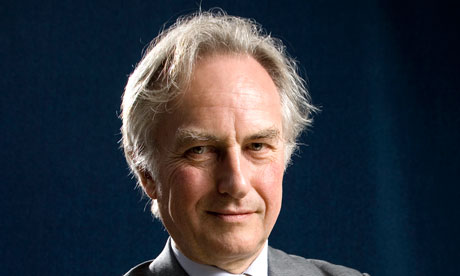
Richard Dawkins expresses dismay over slave owner ancestor story

Richard Dawkins has put down as 'surreal' a Sunday Telegraph article linking his ancestor with the slave trade.
 Photograph: Murdo Macleod  
Richard Dawkins has put down as 'surreal' a Sunday Telegraph article linking his ancestor with the slave trade. Photograph: Murdo Macleod

Sunday 19 February 2012


Evolutionary biologist and atheist calls 'surreal' Sunday Telegraph article citing 18th-century forefather

Richard Dawkins, evolutionary biologist and prominent atheist, is used to criticism from those who do not share his views on religion or the origins of mankind.

But he has expressed surprise at the latest attack, which claims the scientist faces awkward questions because some of his ancestors were slave owners.

The Sunday Telegraph reported that Henry Dawkins had amassed more than 1,000 slaves in Jamaica by the time of his death in 1744, and quoted campaigners calling on Dawkins to pay reparations.

But Dawkins hit back on his blog, describing the interview and subsequent article as "surreal".

"At the end of a week of successfully rattling cages, I was ready for yet another smear or diversionary tactic of some kind," said Dawkins, who clashed on the BBC Today programme with Giles Fraser, formerly canon chancellor of St Paul's cathedral, on Tuesday. "But in my wildest dreams I couldn't have imagined the surreal form this one was to take."

Dawkins said a reporter had called him and named a number of his ancestors who he said were slave owners.

After the reporter quoted the biblical verse about the Lord "visiting the sins of the fathers upon the children unto the third and fourth generation" Dawkins said he ended the conversation.

However, he said the reporter rang back and suggested Dawkins may have inherited a "slave supporting" gene from his distant relative.

"'You obviously need a genetics lesson,' I replied," Dawkins wrote on his blog. "Henry Dawkins was my great great great great great grandfather, so approximately one in 128 of my genes are inherited from him (that's the correct figure; in the heat of the moment on the phone, I got it wrong by a couple of powers of two)."

The article in the Sunday Telegraph went on to state that the "Dawkins family estate, consisting of 400 acres near Chipping Norton, Oxfordshire, was bought at least in part with wealth amassed through sugar plantation and slave ownership."

However, Dawkins said the estate was now a small working farm struggling to survive and "worth peanuts".
Dawkins added: "As it happens, my ancestry also boasts an unbroken line of six generations of Anglican clergymen, from the Rev William Smythies (born 1635) to his great great great grandson the Rev Edward Smythies (born 1818). I wonder if [the reporter] thinks I've inherited a gene for piety too.

"I can't help wondering at the quality of journalism which sees a scoop in attacking a man for what his five-greats grandfather did. Is there really nothing more current going on?"

The Sunday Telegraph declined to comment.

~*~*~*~*~*~*~*~*~*~*~*~*~*~*~*~*~
MY THOUGHTS:

As one can see, even in England the battle by Christians against science is showing itself in what should be objective journalism. In an attempt to discredit Mr. Dawkin by way of his ancestry from hundreds of years ago is so feeble to even be called journalism. The shear ignorance of the reporter and of the editor who approved the story printed in the Sunday Telegraph is also a prime indicator of how journalism has declined in the

Western nations since large corporations have purchased them. The objective now is not seeking the truth in an event, but to create sensationalism to draw readers and then advertising revenue for profit. Yes, of course there has always been a level of this since advertising was introduce into newspapers not long after Gutenberg created the printing press and the printers needed more revenue than what the price of the newspaper could bring in.

And yes, newspapers have always had their biases when reporting political stories. But there was a big shift in the 20th century to create an ethic of objective reporting, not necessarily balanced, but to be as factual as possible.  Today however, we are witnessing the return of the bias of the editor, the owner and of the reporters reflected in the stories and much of it without any fact checking and out right lies, such as with Rupert Murdock's media empire. This includes the famously false reporting by his "Fox News Channel" in the US.

We are witnessing the effects of the Conservative party in England of Margaret Thatcher that has paralleled the conservative movement in the US. Part of this is because of the influence and power of non other than Rupert Murdock. He would make or break anyone running for Parliament in his newspapers in England.

Also part of that parallel is aligning with the Christian religious faction to impose Christian, this time Anglican Law, onto the people. Again this is partially related to Rupert's personal strong Christian belief.

England has experienced the terror of church control of the state, and yes even today, the Anglican Church has great influence in governmental affairs, especially in the smaller villages. Also their royalty must be christened by the church.

Since England does not have a Constitution as such, but more "Common Law" and laws established by parliament, but not guaranteed, they can be changed by any parliament vote or court ruling.

Friday, February 3, 2012

Scientists Fight For Open Access For Research


Select names from your address book   |   Help
   
We hate spam. We do not sell or share the email addresses you provide.

  Scientists Fight For Open Access For Research 

Researchers around the world have expressed concern and alarm about HR 3699, the Research Works Act, which endangers the public’s access to federally-funded research — to research funded by taxpayers’ own contributions. A number of scientists and mathematicians have signed an online pledge at the Cost of Knowledge saying that they will not publish or do any editorial work for Elsevier, the world’s largest publisher of scientific journals, which has declared its support for HR 3699.

A January 21st blog post by Timothy Gowers, a University of Cambridge mathematician who has won the Fields Medal, math’s equivalent of the Nobel Prize, voiced the views of many about Elsevier. “Why do we allow ourselves to be messed about to this extraordinary extent, when one would have thought that nothing would be easier than to do without them?” Gowers wrote.  The online pledge surfaced after a few days and has been signed by over 2,400 biologists, social scientists and mathematicians.

H.R. 3699, The Research Works Act

The reasons for the boycott are far from academic.

The National Institutes of Health made all federally-funded research publications openly accessible in 2008. But HR 3699, which is sponsored by by Rep. Darrell Issa (R-CA) and Committee member Rep. Carolyn Maloney (D-NY), proposes to limit access, based not on who has funded the research (the public or private sector), but by defining research as “private-sector work” based on the “intent” of an author, i.e., the researchers. The American Association of Publishers – self-described “private-sector research publishers” — support HR 3699, on the grounds of seeking “regulatory interference” about the research they publish.

Suppliers and “Middlemen” in Peer-Reviewed Publishing

Currently, scientists, mathematicians and others strive to publish in certain highly regarded peer-reviewed journals. They of course wish to make the results of their research known to the public. Getting an article published in a peer-reviewed journal involves a number of stages after submitting an article: The manuscript is sent to reviewers who are other researchers and who, very often, hold academic positions at universities. The journal’s editorial board makes the decision to publish the article or not. The reviewers are not paid by the journal.

However, to read the research in a journal, you have to have a subscription to it, or to belong to an institution that has one. Elsevier publishes over 2,000 scientific journals including two that are very prestigious, The Cell and The Lancet. Scientists must be familiar with and cite research published in such journals; for researchers who are junior faculty at universities or in post-doctoral positions, getting research published in these journals can make their careers.

Boycott Elsevier

The Chronicle of Higher Education sums up scientists’ concerns about Elsevier:

First there are the prices. Then the company bundles subscriptions to lesser journals together with valuable ones, forcing libraries to spend money to buy things they don’t want in order to get a few things they do want. And, most recently, Elsevier has supported a proposed federal law, the Research Works Act (HR 3699), that could prevent agencies like the National Institutes of Health from making all articles written by grant recipients freely available.

Sean M. Carroll, a prominent cosmologist and senior research associate at the California Institute of Technology, has signed the online pledge; he notes that Elsevier indeed charges “amazingly exorbitant prices to university libraries—and then makes the published papers very hard to access for anyone not at one of the universities.”

In calling for a boycott of Elsevier, researchers  are more than aware that they are the suppliers of content to the journals. Without scientific research, you can’t really have a scientific journal.

Scientists are attempting to publish without the likes of Elsevier and other private-sector publishers at sites including F1000 research and the arXiv, at which physicists and mathematicians can post work in progress. Such “instant publishing” is still in its infancy as a valid, and validated, venue for scientific research.

But I commend these researchers’ intentions and efforts. I’m an academic at a small, chronically under-funded urban college. We don’t have access to a number of publications because the subscription costs are just too high. My college is not a research institution but the more research that is available via open access, the more our students — the more that anyone — can benefit.